
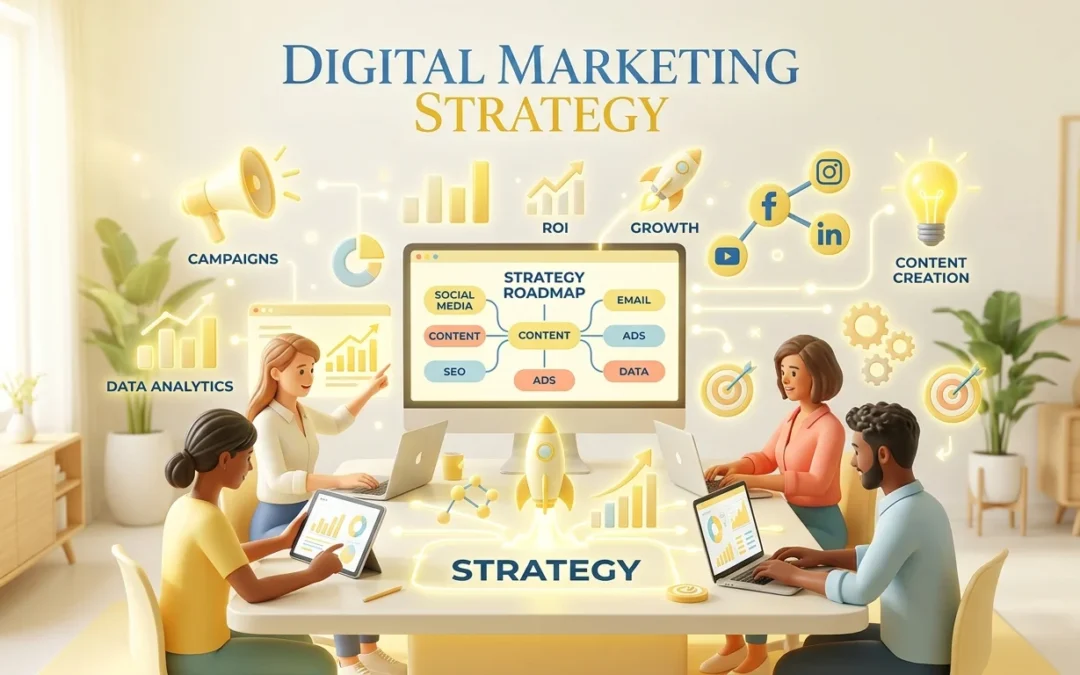
In the current competitive world of the internet, an effective Digital Marketing Strategy is a necessity in business success. Even the best services or products cannot be presented to the best audience without a properly designed plan. The powerful strategy does not only enhance the visibility but also guarantees the increased conversions and future growth.
Regardless of being a startup or the established business, knowing how to develop the results-oriented Digital Marketing Strategy can be of a huge difference. A professional digital marketing agency is also the partner of many companies to make sure that their strategy is consistent with the industry best practices and can bring measurable outcomes.
What Is a Digital Marketing Strategy?
Digital Marketing Strategy is an elaborate plan which defines how a business will leverage on the online channels to attain its marketing objectives. It incorporates all the search engine optimization and content marketing to the social media and paid advertising.
Any Digital Marketing initiative is not aimed at attracting traffic only but also turning the traffic into leads and customers. An effective planning approach will make sure that all marketing efforts will lead to the expansion of the business.
Why a Strong Digital Marketing Strategy Matters
Devoid of direction, the businesses tend to be wasting time and resources on useless campaigns. A clear Digital Marketing Strategy is the one that will allow you to target the correct audience, select the most appropriate channels, and provide an uninterrupted message.
With the help of a voracious digital marketing company, companies will be able to develop strategies which are data-oriented and specific to the particular objectives. This will guarantee improved performance and increment in the returns.
Step 1: Define Your Goals and Objectives
The initial step towards achieving a successful Digital Marketing Strategy is the clear definition of goals. These objectives are to be in conformity with your general business objectives.
You need to have clear objectives whether you want to drive traffic to your websites, create leads or to make more sales to determine success. When it comes to Digital Marketing, it is necessary to have realistic and measurable objectives when it comes to gauging the progress.
Step 2: Understand Your Target Audience
The first thing to any successful Digital Marketing Strategy is the knowledge of your audience. You must know who the customers are, their needs, as well as their online behaviors.
With the help of demographics, interests, and online behavior analysis, businesses are able to design individual campaigns that will be appealing to their audience. There are sophisticated tools that would be applied by a professional digital marketing agency to collect and analyze this data.
Step 3: Choose the Right Marketing Channels
Marketing channels are not the same fit in all businesses. The Digital Marketing Strategy is powerful and is concerned with the channels that have the most active target audience.
These may be search engines, social media, email marketing as well as content marketing. The choice of channels is a sure way of making your Digital Marketing efficient and effective.
Step 4: Create High-Quality Content
The content is very important in any Digital Marketing Strategy. It assists in drawing your audience, interacting with them, and turning them into converts.
The content should be of high quality and meet the customer needs, as well as answer questions. It could be blog posts, videos, or updates to social media, but it should be fitted to the general Digital Marketing objectives.
An experienced digital marketing company will be capable of generating search engine optimized and interesting content.
Step 5: Optimize for SEO and User Experience
The optimization of search engines is one of the elements of the effective Digital Marketing Strategy. Through optimization of your webpage and contents, you will be able to increase your presence in search engines and get organic traffic.
User experience is also important besides the use of SEO. The speedy, mobile-friendly, and convenient to navigate web site will guarantee that the visitors will spend more time and have a higher chance of conversion.
Step 6: Implement and Monitor Your Strategy
After having a Digital Marketing Strategy, it is time to put it to use. The implementation process is however not the stop but is the start.
This is because it is important to constantly monitor your strategy and make sure it is performing as anticipated. In Digital Marketing, information is essential in telling what works and what requires to be improved.
Step 7: Optimize and Improve Continuously
There is a successful Digital Marketing Strategy that is not fixed. It is developed in accordance with the performance information and requesting variations in the market trends.
Here are key areas to focus on for continuous improvement:
- Analyze website traffic and user behavior
- Track conversion rates and campaign performance
- Update content regularly for better engagement
- Test different marketing approaches and strategies
- Adjust campaigns based on real-time data
The services of a professional digital marketing agency make sure that the strategy is refined with each passing day and brings improved outcomes.
The Role of a Digital Marketing Agency
The creation and operation of a high working Digital Marketing Strategy entails skills, time, and funds. This is the reason why a large number of companies prefer to engage a professional digital marketing agency.
A professional agency will offer a strategic direction, introduce, and deploy innovative solutions, and make sure that every bit of the Digital Marketing supports your company. This does save time as well as enhance performance.
(FAQs)
1. What is a Digital Marketing Strategy?
A Digital Marketing Strategy is a plan that outlines how a business uses online channels to achieve its marketing goals.
2. Why is a Digital Marketing Strategy important?
It helps businesses reach the right audience, improve conversions, and achieve long-term growth.
3. How can a digital marketing agency help?
A digital marketing agency provides expertise, tools, and strategies to create and manage effective marketing campaigns.
4. What are the key components of Digital Marketing?
Key components include SEO, content marketing, social media marketing, email marketing, and paid advertising.
5. How often should I update my Digital Marketing Strategy?
A Digital Marketing Strategy should be reviewed and updated regularly based on performance and market trends.